
Using AI to Run Social Media: What Works and What Still Needs a Human

Search for an AI social media manager and you get a wall of product pages. Almost every one of them answers the same question: which tool should you buy? The most interesting result on that page is not a product at all. It is a Reddit thread titled, roughly, "do these actually work?" That is the real question, and nobody is answering it straight.
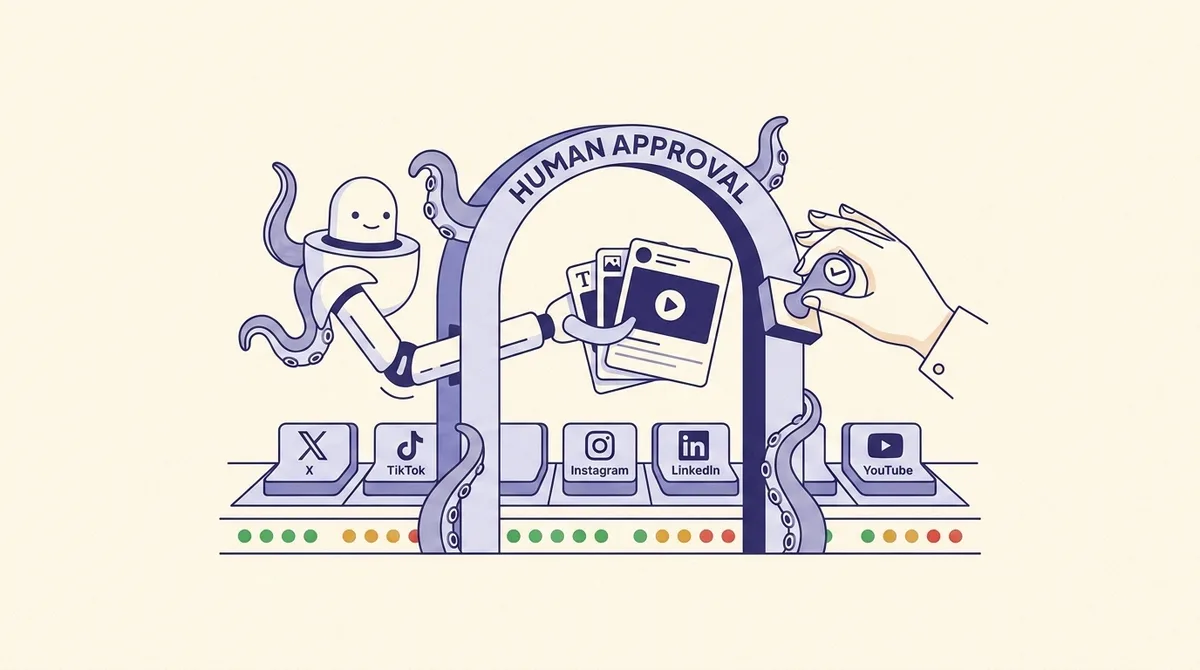
Here is the answer in one paragraph. AI is genuinely excellent at a narrow band of social media work, decent but supervision-hungry at a wider band, and bad at the part your clients are actually paying for. More importantly, the ceiling on what an "AI social media manager" can do is not set by model quality. It is set by what the platform APIs permit, and by disclosure rules that came into force three weeks before this article was published. TikTok's developer policy, for example, requires that a human sees and consents to a post before your integration sends it. That is not a nice-to-have workflow preference. It is a condition of the API.
So this piece is a capability map rather than a buying guide. Green for what to automate today, amber for what to draft and review, red for what to keep human. Then a reference architecture for how an agent-driven publishing loop should actually be wired, and the specific platform constraints that quietly degrade "AI runs my social" into "AI posts flat single images everywhere."
What do people actually mean when they search for an AI social media manager?
Three different jobs hide behind that phrase, and they have very different success rates.
The first is an assistant: something that writes captions, suggests hooks, resizes assets and drafts a month of ideas while you stay in the driver's seat. This works well and has worked well for a while.
The second is an operator: a system that takes a source (a blog post, a podcast, a product launch) and produces a full week of platform-specific posts, queued and scheduled, with you approving them. This works, with caveats, and it is where most of the real time savings live.
The third is an autonomous agent: something that decides what to say, says it, and publishes without a human touching the post. This is what a lot of the current marketing is selling, and it is the one you should be most careful with. Not because the model cannot write a decent post. Because on at least one major platform, publishing without a human preview and explicit consent violates the terms your integration agreed to.
If you are still choosing between categories of software rather than architectures, our guide to picking social media management tools covers the evaluation criteria that matter before you get to the AI layer.
Where is AI genuinely reliable, and where does it fall over?
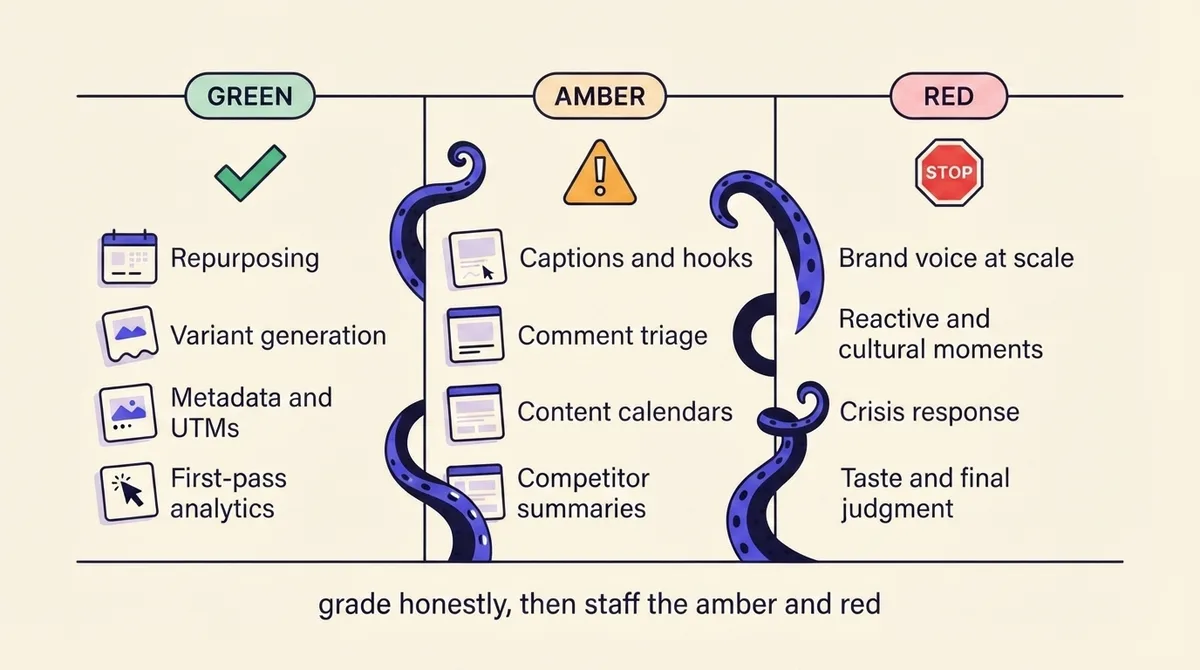
Grade every task honestly. Most vendor content refuses to write "red" anywhere, which is exactly why operators do not trust it.
Green: automate this and stop thinking about it.
- Repurposing one long asset into many short ones. Taking a 2,000-word post and producing a thread outline, five caption variants, a carousel script and a video hook list is mechanical transformation work. AI is faster and does not get bored on item nine.
- Per-platform variant generation. Same message, four different length limits, four different tonal registers, four different link-handling behaviors. This is rules-plus-rewriting, and it is the single highest-leverage automation in the stack.
- Metadata hygiene. Alt text drafts, UTM parameters, filenames, internal tagging, first-pass hashtag sets. Boring, high-volume, low-consequence if slightly off. If you want to see the shape of it before wiring anything up, the caption generator is the same transformation in a single-shot form.
- First-pass analytics reading. "Which five posts overperformed relative to their format's median, and what do they share?" is a summarization task with a verifiable answer.
Amber: strong first drafts, always a second pair of eyes.
- Captions and hooks for owned campaigns. Usable output, but the opening line is where brand personality lives and where models regress to the mean fastest.
- Comment and DM triage. Great at classification and routing, risky at replying. Let it sort and suggest; let a human send anything that is not a genuine FAQ.
- Content calendars. AI will happily fill 30 slots. It will not know that slot 14 collides with your competitor's conference or your own pricing change.
- Competitive and trend summaries. Useful directionally, frequently confidently wrong on specifics. Verify anything you plan to repeat publicly.
Red: keep this human, and be honest about it.
- Brand voice at scale. A model can imitate a voice for a paragraph. Across 200 posts a month it drifts toward a generic, upbeat, over-polished register that audiences now recognize instantly. Voice is the product, and it degrades under volume.
- Reactive and cultural content. The 2025 Sprout Social Index, based on responses from 4,044 consumers who follow at least five brands, plus 900 practitioners and 322 marketing leaders, concluded that "Consumers want brands to understand the context of key cultural moments, not recreate every meme." Context is judgment. Models do not have it. (2025 Sprout Social Index)
- Crisis response and anything legally sensitive. Obvious, still worth writing down in your runbook.
- Final go or no-go. Someone has to be accountable for the thing that went out. That is not a philosophical point, as the next two sections show. It is a compliance one.
Why is the human approval gate mandatory rather than optional?
This is the part almost every guide on the subject skips entirely, and it is the part that should reshape your architecture.
Start with TikTok. Its Content Sharing Guidelines state that "API Clients should display a preview of the to-be-posted content" and that "API Clients must only start sending content materials to TikTok after the user has expressly consent to the upload." It goes further: "The users of API Clients must have full awareness and control of what is being posted to their TikTok accounts." Title, privacy status, interaction settings and commercial content disclosure must be entered or selected by the user, and privacy status specifically carries no default value. (TikTok Content Sharing Guidelines)
Read that again with the autonomous-agent pitch in mind. A system that generates a TikTok post and publishes it without a human seeing a preview and consenting is not a more advanced product. It is a non-compliant one. At least one competing explainer on this topic argues directly against per-post approval on the grounds that it "defeats the speed advantage." On TikTok, that speed advantage is not yours to take.
There is a second gate before you even get there. TikTok's Content Posting API documentation states that "All content posted by unaudited clients will be restricted to private viewing mode." Until an integration passes TikTok's audit, everything it publishes is private. Any vendor promising autonomous public TikTok posting is describing something that either passed audit under a human-consent design or is not doing what it claims.
Now the law. EU AI Act Article 50(4) requires deployers of AI systems that generate or manipulate text published to inform the public on matters of public interest to disclose that the content is artificially generated. But it exempts content that "has undergone a process of human review or editorial control and where a natural or legal person holds editorial responsibility for the publication." Under Article 113, these obligations apply from 2 August 2026. (EU AI Act Article 50)
That inverts the usual framing. The approval queue is not friction you tolerate for safety reasons. It is the mechanism that discharges a disclosure obligation, because a named human reviewed the draft and holds editorial responsibility for it. Fully autonomous publishing removes that defense at precisely the moment you would most want it.
Platform-side labeling does not save you either. Meta says it will "require people to use this disclosure and label tool when they post organic content with a photorealistic video or realistic-sounding audio that was digitally created or altered, and we may apply penalties if they fail to do so," while conceding that "it's not yet possible to identify all AI-generated content, and there are ways that people can strip out invisible markers." (Meta newsroom, February 2024) Detection is imperfect and the obligation still lands on the publisher. Your process is the control, not their classifier.
What should the publishing loop actually look like?
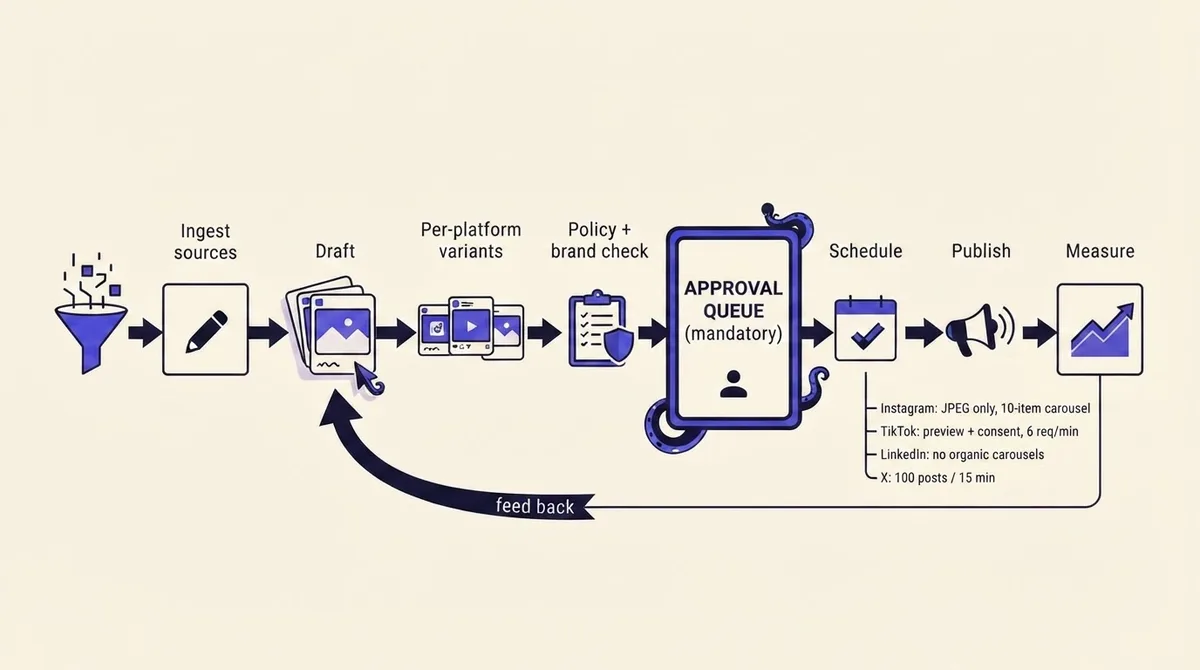
Every node here earns its place, and the order matters.
- Ingest sources. Blog posts, transcripts, changelogs, customer calls, docs. An agent with no grounding invents; an agent with a source library summarizes. This is the difference between output you edit and output you delete.
- Draft. One canonical message per idea, platform-agnostic, with the claim and the angle stated plainly.
- Generate per-platform variants. Not copy-paste with different hashtags. Different length, different link handling, different opening line, different media requirements.
- Policy and brand check. An automated pass before a human ever sees it: banned claims, competitor mentions, unapproved statistics, missing alt text, disclosure flags for AI-generated media, character limits.
- Approval queue. Mandatory. Human sees the exact rendered preview per platform, per account, and approves or rejects. This node is where TikTok compliance and Article 50 editorial responsibility both live.
- Schedule. Rate-limit aware, timezone aware, spacing aware.
- Publish. Per-platform API calls with per-platform constraints enforced at the boundary.
- Measure, then feed back. Post-level results return to the draft stage as context, not as vanity dashboards.
The reason to draw it is that most "AI social media agent" products collapse steps 2 through 7 into one opaque box, and every failure mode hides in that box. Ours does not: OctoSpark generates the variants, and they land in a client approval queue before anything reaches a platform. That is not us being cautious. It is the only architecture the platform rules permit.
What do the platforms actually let an agent publish?
This is the ceiling almost nobody talks about. Model quality is not your limiting factor. API surface is.
Instagram. The Content Publishing API supports JPEG as the only image format, with extended formats such as MPO and JPS unsupported. Carousels are capped at 10 items and every image is cropped based on the first image in the carousel, defaulting to 1:1. Shopping tags and filters are not supported. An alt_text field arrived on 24 March 2025 for image posts only, with Reels and Stories explicitly excluded. Accounts are limited to 100 API-published posts per rolling 24 hours, and a carousel counts as one. (Instagram content publishing docs)
Read those constraints as a content strategy, because that is what they become. Your agent cannot ship a shoppable post. It cannot apply a filter. It cannot write alt text on your Reels. If your carousel design assumes mixed aspect ratios, the first slide silently dictates the crop for all of them.
TikTok. Direct Post limits each user access token to 6 requests per minute, caps titles at 2,200 UTF-16 runes, and exposes brand_content_toggle for paid partnerships promoting a third party and brand_organic_toggle for promoting your own business. (TikTok Direct Post API reference) Six per minute is generous for one account and immediately relevant if you are running dozens for clients.
LinkedIn. The Posts API cannot create organic carousel posts at all; carousels are sponsored-only, while MultiImage posts and polls are organic-only. The API also "does not support URL scraping for article post creation, as it introduces unpredictability in how a post will appear when created by API partners," so your system must supply thumbnail, title and description itself. After publishing, only commentary, contentCallToActionLabel, contentLandingPage, lifecycleState and adContext can be updated, so attached media cannot be swapped. Targeted organic posts need an audience above 300 members. (LinkedIn Posts API)
That last one matters operationally. If an agent publishes a LinkedIn post with the wrong image, there is no fix-in-place. You delete and repost, losing whatever engagement it had. Approval before publish is the only recovery mechanism.
X. Post creation is rate-limited to 100 requests per 15 minutes per user and 10,000 per 24 hours per app. (X API rate limit documentation) Comfortable for a single brand, a real capacity planning input if you are an agency fanning out across accounts from one app.
Add these up and you get the honest reason AI-run accounts look flat: the automatable surface is single images and plain text, so unattended systems drift toward exactly that. Anything richer, a designed carousel, a shoppable post, a Reel with proper alt text, needs a human in the pipeline. It is also why cross-posting one identical asset everywhere fails: the variant layer has to differ per network, deliberately rather than accidentally.
How do you run this for clients without getting burned?
The failure modes are predictable, so plan for them.
The first is voice collapse. Month one reads sharp; month four reads like every other AI account. Catch it by sampling: pull 10 random published posts each month and score them blind against your voice guide. If a stranger cannot tell them from a competitor's, you have drifted. A written, specific brand voice guide is what makes that check possible at all.
The second is the confident wrong fact. Models restate product details, pricing and stats that were true two quarters ago. Your policy check should hard-block unapproved numbers rather than trusting review to catch them.
The third is liability. If you run accounts for clients, write down who holds editorial responsibility for each account, per Article 50's exemption language. In practice, that means named approvers, logged approvals and a retained record of who clicked publish. If your tool cannot show you that log, it cannot support the claim.
A 30-day pilot that actually tells you something:
- Days 1 to 5. Pick one account and one format. Load real sources. Do not connect publishing yet.
- Days 6 to 15. Agent drafts, human approves everything. Track edit rate per post: how many drafts ship untouched, how many need light edits, how many get binned. Edit rate is your real quality metric, not output volume.
- Days 16 to 25. Turn on scheduling for approved posts only. Measure time saved per post against the baseline you recorded in week one, and check that your posting cadence still lines up with when your audience is actually active. Our post-level timing data is a reasonable starting point.
- Days 26 to 30. Review published performance against the prior month, then decide what moves from amber to green. Nothing moves to fully unattended.
If edit rate is above roughly half by day 25, the problem is almost always your source library, not the model.
So is AI replacing social media managers?
No, and the reason is more specific than "AI lacks creativity."
The work splits into production and judgment. Production, generating variants, writing metadata, reformatting, summarizing results, is being automated fast and you should let it be. Judgment, deciding what is worth saying, whether this lands today, whether it sounds like us, whether we publish at all, is not only unautomated but is now structurally required by TikTok's developer policy and rewarded by the EU AI Act's editorial-responsibility exemption.
What changes is the job's shape. Fewer hours writing captions. More hours defining voice, curating sources, tuning the policy layer and reviewing a queue. The operator who runs 30 accounts with an agent and a strict approval gate beats both the person doing it all by hand and the person who wired an agent straight to a publish endpoint and stopped watching.
If you want that shape without building it, that is what OctoSpark is: agent-generated drafts, per-platform variants, a mandatory approval queue, and scheduling across X, TikTok, Instagram, LinkedIn, YouTube, Facebook and Threads, drivable from a dashboard, a terminal or your own agent via API and MCP. Start with the social media scheduler and wire the agent in once the approval queue is doing its job.