
Letting an AI Agent Post to Social Media Safely

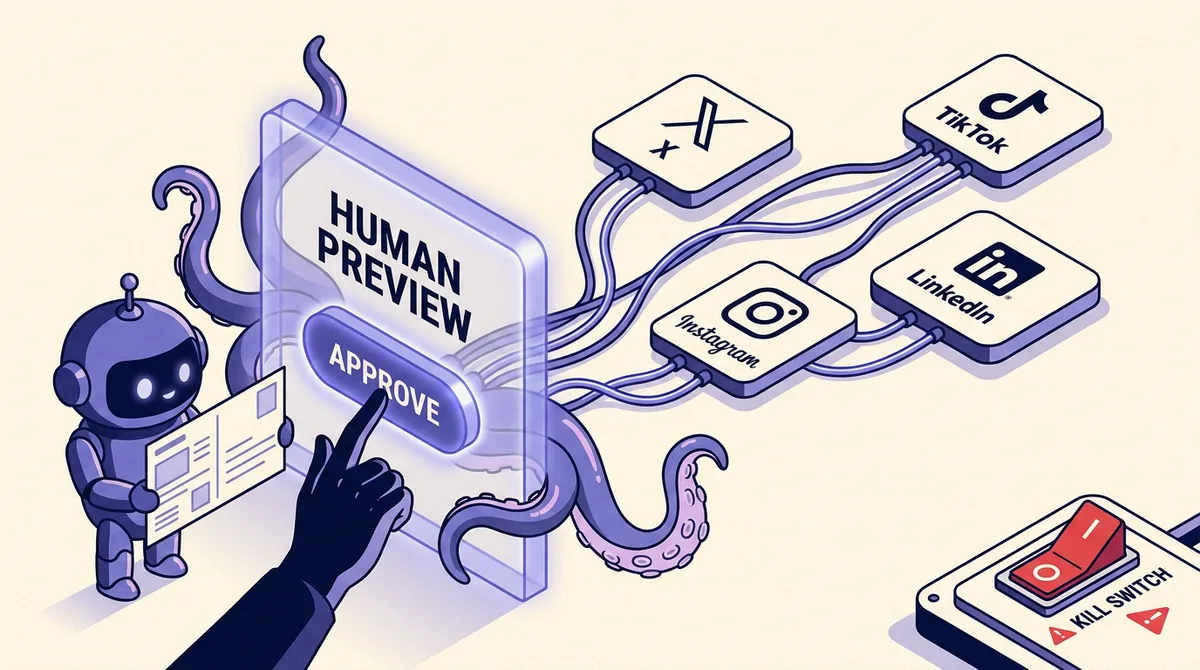
Almost every article about AI agent social media posting answers the same question: which ready-made agent should you buy to post for you. That question has a dozen decent answers and none of them are interesting. The question nobody answers is the one you will actually face at 2am: how do you give a model publish access to a real account without it torching that account, and without your app getting cut off from the API entirely?
Here is the fact that reframes the whole category. Fully autonomous, set-and-forget posting is not just risky. On the two platforms people most want to automate, it is already prohibited by developer policy. X's Developer Policy requires that any service letting people post to X must, before publishing, "Show exactly what will be published," and separately requires "express and informed consent from people before doing any of the following: Taking any actions on their behalf. This includes (but is not limited to): Posting content to X" (X Developer Policy, checked September 2026). TikTok's Content Sharing Guidelines are blunter still: "users of API Clients must have full awareness and control of what is being posted to their TikTok accounts," plus a required preview, editable preset text and hashtags, and a privacy dropdown with "no default value" (TikTok Content Sharing Guidelines, checked September 2026).
The security world independently landed on the same conclusion. OWASP's LLM06:2025 Excessive Agency uses this exact use case as its canonical example: "an LLM-based app that creates and posts social media content on behalf of a user should include a user approval routine within the extension that implements the 'post' operation" (OWASP LLM06:2025). So the design target is not autonomy. It is a fast, low-friction human checkpoint wrapped in guardrails that hold when the model does something surprising. This is the reference implementation for that.
Autonomous posting is not the hard part, not getting suspended is
Wiring a model to a publish endpoint is a weekend. Any agent with a bearer token and an HTTP tool can push a post. The hard part is everything the roundups skip: what happens when the model hallucinates a competitor's name into a caption, when a prompt-injected source page tells it to post a link, when a retry loop fires the same payload eleven times, when the token silently expires mid-quarter, or when your naive cross-poster ships byte-identical copy to five accounts and X reads that as coordinated inauthentic behavior.
OWASP names the three root causes precisely: excessive functionality, excessive permissions, and excessive autonomy. Every guardrail below attacks one of those three. None of them are about prompt engineering, and that is deliberate. A guardrail written as "you must always ask before posting" lives in a system prompt that the next model upgrade, context truncation, or injected instruction can override. A guardrail written as a scope your token does not have, or a state machine your publisher refuses to leave, survives all of it.
Three levels of agent autonomy, and which one you actually want
- Suggest. The agent drafts, a human posts. Zero API write access required. Safe, but the human is still the bottleneck on volume.
- Act with approval. The agent assembles the complete rendered payload, including media, alt text, privacy setting and disclosure flags. A human approves that exact payload. The system publishes. This is the level the platform policies above actually describe, and the level worth engineering well.
- Bounded autonomy. The agent publishes without a per-post human, but only inside an explicitly enumerated blast radius: one account, one content class, a hard daily cap, no links, no @-mentions, business hours only.
Level 3 is legitimate for narrow cases. It is not legitimate as a default across every connected account, which is what "set a content goal and it executes across all your platforms" quietly implies.
Guardrail 1: scope the credential, not the prompt
OWASP's AI Agent Security Cheat Sheet puts it plainly: "Grant agents the minimum tools required for their specific task. Implement per-tool permission scoping (read-only vs. write, specific resources)." On social APIs that means naming the scope, not the intent.
- Instagram: publishing needs
instagram_business_basicplusinstagram_business_content_publishwith Instagram Login, orinstagram_basic,instagram_content_publishandpages_read_engagementwith Facebook Login. Meta's permission reference describesinstagram_content_publishas creating "organic feed photo and video posts on behalf of a business user," andpages_manage_postsas "create, edit and delete your Page posts" (Meta permissions reference, checked September 2026). Both require Meta App Review before your app can touch any account outside your development team, so plan review time into the roadmap. - LinkedIn:
w_member_socialposts "on behalf of an authenticated member."w_organization_socialis separate and role-gated: LinkedIn restricts it to organizations where the authenticated member holds ADMINISTRATOR, DIRECT_SPONSORED_CONTENT_POSTER or CONTENT_ADMIN. An agent that only ever posts to a company page should never hold the member scope. - X:
tweet.writeis what publishing needs.tweet.moderate.write,dm.writeandmedia.writeare separate grants. Do not bundle them into one app credential because the OAuth screen made it easy. - TikTok:
video.publishcovers direct posting,video.uploadcovers the upload-to-inbox flow where the creator finishes the post in the TikTok app. Uploading to the inbox is a materially safer default, and TikTok restricts unaudited clients anyway: "All content posted by unaudited clients will be restricted to private viewing mode" until you pass their audit.
Worked example. An agency agent that drafts and schedules for twelve client LinkedIn pages should hold exactly w_organization_social, per-organization, with each client's grant stored separately. If a prompt injection convinces the model to post to the founder's personal profile, the request fails at the API with a permission error rather than succeeding and becoming an incident report. That is the whole point: the failure is structural, not behavioral.
Guardrail 2: draft-only by default, and why the platform will not do it for you
The instinct is to have the agent create a platform-native draft and let a human publish from the platform app. On LinkedIn, that does not work, and the reason is worth internalizing.
LinkedIn's Posts API documents four lifecycleState values (DRAFT, PUBLISHED, PUBLISH_REQUESTED, PUBLISH_FAILED) but states that PUBLISHED "is the only accepted field during creation" (LinkedIn Posts API, checked September 2026). You can read a draft back with viewContext=AUTHOR. You cannot create one. There is no API call that produces a reviewable, unpublished LinkedIn post.
That is an architectural conclusion, not a preference: the draft state has to live in your system. Your database holds the canonical record with a status of draft, pending_approval, approved or published, and the platform API is only ever called at the final transition. Every agent write path terminates in your store, never at a provider endpoint. If you are building this yourself, our builder's guide to publishing programmatically walks the endpoint-level mechanics for each network; this section is about the state machine that sits in front of them.
Two practical consequences. First, your draft record must store the fully rendered, per-platform payload, not the generic idea. A 280-character X post and the LinkedIn variant are different rows, because approval has to bind to what ships. Second, media has to be resolved at draft time. If the agent references an image that gets regenerated between approval and publish, the human approved something that no longer exists.
Guardrail 3: approval gates and rate limits that actually bind
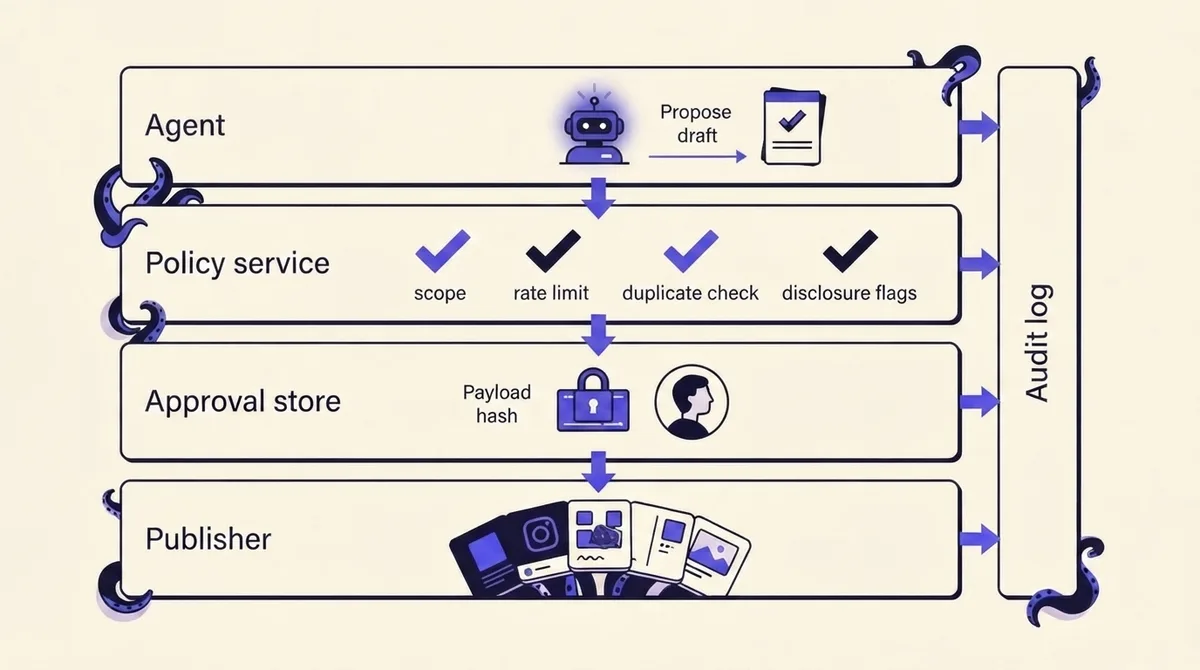
An approval gate that records "Dana said yes to the Thursday LinkedIn post" is not a gate. It approves an intent, and the agent can render a different payload afterwards. OWASP's cheat sheet is specific about the fix: "Separate decision-making from execution. The agent can propose an action, but a policy service or execution component should independently validate scope, privilege, and approval state before execution."
Concretely, hash the exact outbound payload:
- The agent proposes. Your system renders the final payload: text, media IDs, alt text, link, scheduled time, privacy level, disclosure flags.
- Compute a stable hash over that canonical payload and store it on the approval record with the approver's ID, timestamp, and the policy version in force.
- The publisher accepts a payload plus a hash. It recomputes, compares, and refuses on mismatch. Any edit after approval invalidates the approval and returns the post to
pending_approval. - Fail closed. If the policy service is unreachable, nothing publishes. A queued post is recoverable; a wrong post is not.
Rate limiting is the second half, and OWASP recommends it explicitly as defence in depth: "Implement rate-limiting to reduce the number of undesirable actions that can take place within a given time period." Published platform ceilings, all checked September 2026:
- Instagram: 100 API-published posts per 24-hour moving period, with remaining quota readable from
GET /<IG_ID>/content_publishing_limit(Meta Instagram Platform content publishing docs). Poll that endpoint before you queue, rather than discovering the wall on the 101st call. - X: POST /2/tweets allows 100 requests per 15 minutes per user and 10,000 per 24 hours per app (X API rate limits documentation).
- TikTok: the direct post endpoint states "Each user access_token is limited to 6 requests per minute" (TikTok direct post reference).
Set your own ceiling far below all of these. A runaway loop that posts 100 legitimate-looking Instagram posts in an hour is technically within the platform limit and is still a catastrophe for the account. A cap of eight posts per account per day with a per-hour burst limit of two costs you nothing in normal operation and converts the worst-case incident from unrecoverable to a morning of deletions.
Guardrail 4: audit logs, rollback, and the kill switch
No competitor page on this topic mentions audit logging, and it is the control you will want most during an actual incident. Log the publish decision, not just the HTTP result. OWASP's cheat sheet specifies audit events should capture "action classification, risk score when applicable, authorization outcome, approval identifier, execution result, and policy version." For posting, the minimum useful record is: the final payload and its hash, the model and version that produced it, the source material or reasoning trace behind it, the approver, the policy version, the platform response including the returned post ID, and the timestamp.
That last field matters more than it looks. Without the returned post ID you cannot roll back automatically, and rollback is per-platform:
- LinkedIn: delete by post URN. Usefully, deletes are idempotent: "Deletion requests for a previously deleted UGC Post will return a 204 code - No Content." Retries are therefore safe. Batch delete is not supported, so a mass rollback is a loop with your own rate limiting.
- X: DELETE /2/tweets/:id per post.
- Instagram and Facebook: deletion of Page content requires
pages_manage_posts; note that this is a permission your publishing agent may not otherwise need, so decide deliberately whether the rollback path uses a separate, human-triggered credential.
Build the kill switch as a flag the publisher checks, not as "stop the agent." Killing the agent process leaves scheduled jobs in flight. A publishing_enabled: false flag read at the publisher, plus a queue drain that moves everything back to pending_approval, stops the bleeding in one toggle.
Compliance the agent has to carry: disclosure, duplicates, and tokens
Three things every ranking page on this topic misses entirely.
AI disclosure is a field, not an ethics paragraph. TikTok's direct post endpoint accepts is_aigc: "Set to true if the video is AI generated content. If set, the video will be labelled with Creator labeled as AI-generated tag in video's description." It also takes brand_content_toggle and brand_organic_toggle for branded content, plus disable_comment, disable_duet and disable_stitch. It requires a privacy_level matching an option returned by the creator info query endpoint. An agent pipeline that never sets these is quietly non-compliant, and a pipeline that hardcodes a privacy default violates the "no default value" rule. Carry disclosure state as a first-class column on the draft, set at generation time by the component that made the media.
Duplicate content is a suspension risk, not a style problem. X's Developer Policy says: "Never post identical or substantially similar content across multiple accounts," and that you "may not register multiple applications for a single use case or substantially similar or overlapping use cases." A naive cross-poster does exactly the prohibited thing by design. If you manage several X accounts, the agent must generate genuinely distinct copy per account, and your policy service should reject a payload whose normalized text closely matches anything published from another account in a rolling window.
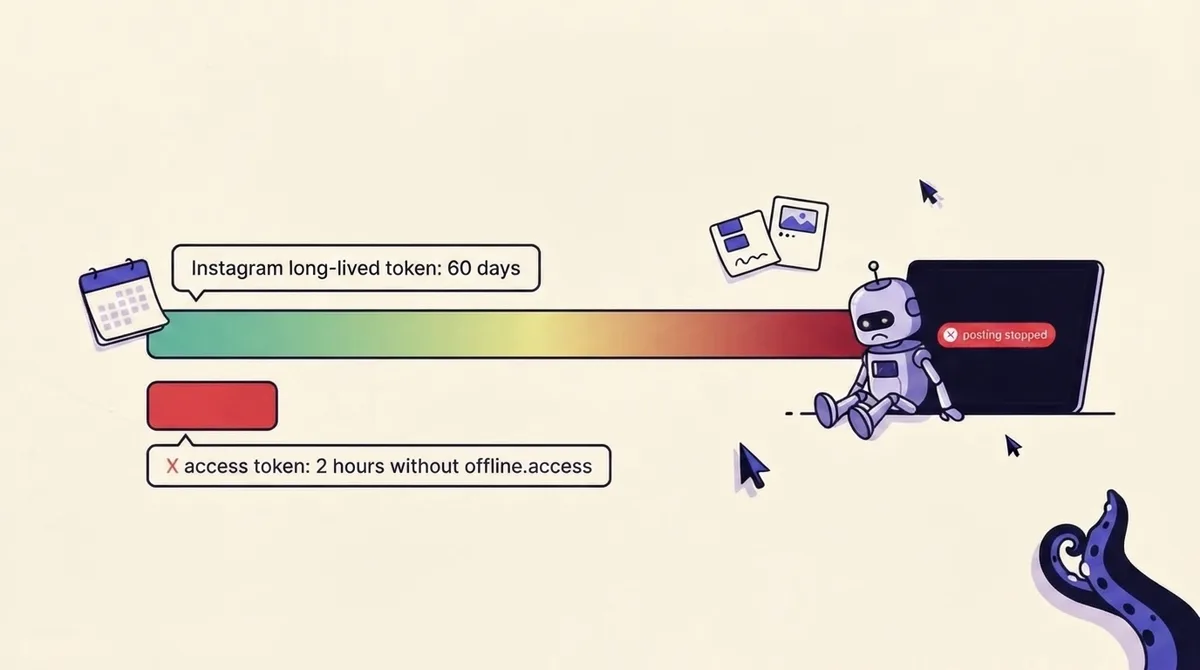
Token expiry will stop your agent silently. Instagram long-lived tokens are valid for 60 days, and Meta is explicit that "Tokens that have not been refreshed in 60 days will expire and can no longer be refreshed." There is no recovery beyond re-authorizing the account. X access tokens from the Authorization Code Flow with PKCE "will only stay valid for two hours unless you've used the offline.access scope." Refresh on a schedule at roughly half the lifetime, alert on refresh failure, and treat a failed refresh as a paging incident rather than a log line. This is the failure mode that hits three weeks after launch, when everyone has stopped watching.
The rollout ladder and a pre-flight checklist
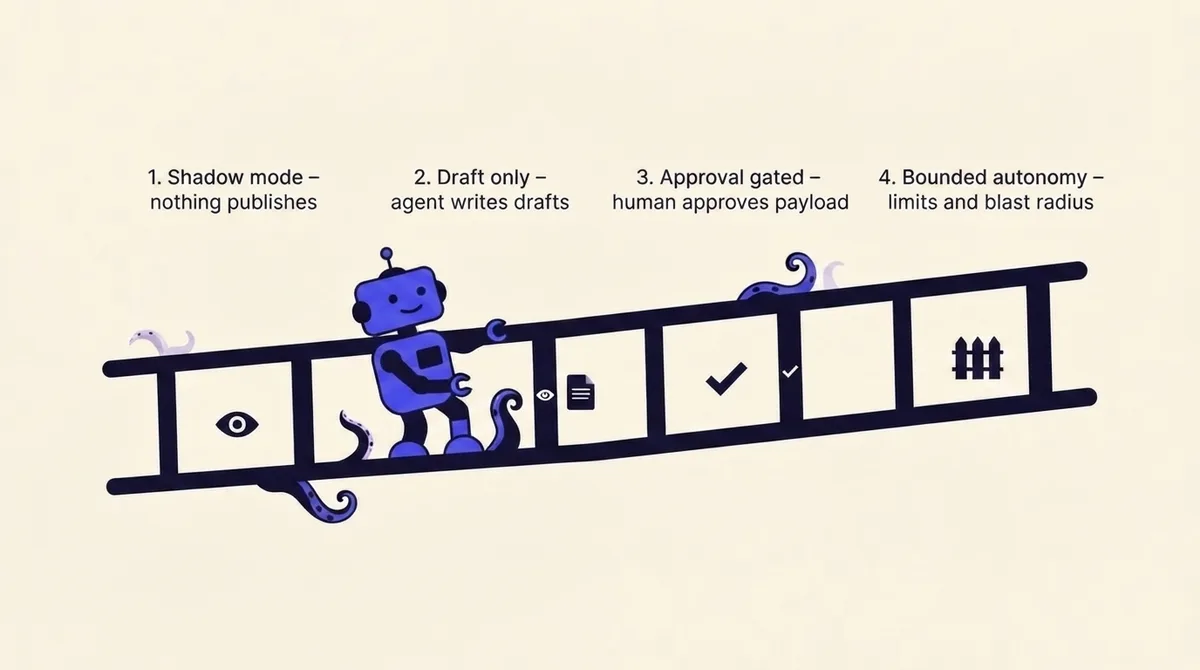
Do not go from nothing to autonomous. Climb:
- Shadow mode. The agent proposes; nothing publishes and no write scopes are granted. For two weeks, diff its proposals against what your human actually posted. You are measuring how often you would have shipped it unedited.
- Draft-only. Grant write scopes, but the publisher is hard-disabled. Drafts land in your queue. You are now testing payload rendering, media handling, and per-platform variants.
- Approval-gated. Turn on the publisher behind hash-bound approvals. Watch the audit log, not the feed.
- Bounded autonomy. Only for a narrow, proven content class. Write the blast radius down explicitly: which account, which class, daily cap, allowed hours, no links, no mentions of people or competitors, automatic pause after any single deletion.
Before rung three, run this:
- Scopes granted are the minimum set, and you can name each one.
- Draft state lives in your database, not the platform.
- Approvals bind to a payload hash and invalidate on edit.
- Your own rate ceiling is well under the platform's, per account and per hour.
- Every publish writes an audit record including approver, model version, and policy version.
- Rollback is tested: you have deleted a real post through the code path.
- The kill switch is a publisher-side flag and someone has flipped it in a drill.
- Token refresh is scheduled and refresh failure pages a human.
- Disclosure flags are populated at generation time.
- Duplicate detection runs across accounts before publish.
If you would rather not build all of this, that is the honest case for using a platform: OctoSpark's client approval workflow implements the payload-bound gate, the audit trail and the per-account ceilings, and exposes the same publishing surface to your dashboard, terminal, and any agent over the API or MCP. Either way the design is the same, and the sequence matters more than the tooling. For the human-process side of this, our guide on setting up a social media approval workflow covers roles and turnaround, and what AI can and cannot run unattended is a useful reality check on where the judgment calls still sit.
The agents are ready to post. The platforms have already told you they want a human in the loop, and the security literature agrees. Build the loop well enough that it takes ten seconds, and you get most of the speed with none of the suspension risk.